

It all started with a good old Moskvich (AZLK) 2141 that had been sitting for 8 years after an accident and had rusted heavily — especially the floorpan, though the upper body shell remained in decent shape. The UZAM engine was in great condition and started easily in any weather. Selling it wasn’t interesting; restoring it seemed much more appealing. The initial decision was to try repairing and firing up the engine first. After 8 years of sitting, the engine came back to life. Once the brakes were rebuilt and a few adjustments were made, the car was drivable again. Its simplicity and reliability were its most attractive qualities. In this state, the car covered over 1,000 km with only a handful of minor issues — hardly surprising for a vehicle that had stood idle for so many years.
Since the core mechanical assemblies turned out to be solid, the next step was to decide on the direction of the build.
Restoring it back to factory original meant considerable labor with limited prospects, as spare parts for the M2141 are becoming scarcer by the day and quality issues continue to grow.
Building an off-road amphibious vehicle seemed like a much more interesting path.
The initial idea was a load-bearing displacement hull (“tub”) with welded-in frame sections from a UAZ-452 (“Bukhanka” van), while preserving the exterior look of the M2141 as much as possible.
Why the UAZ Bukhanka? In the author’s view, it is a vehicle close to the ideal — with simple, reliable assemblies offering a massive margin of safety for a project like this, and already very familiar 😉
Design ideas were also drawn from previously built Soviet amphibians such as the GAZ-46, LuAZ-967, BRDM-1, BRDM-2, and others.
Design Layout
Structural System
The plan was to use two front frame sections from a UAZ Bukhanka: in stock configuration at the front, and widened at the rear so that the leaf springs lined up with the rear axle mounting pads. Using the front frame section at the front was driven by the fact that it is a proven, ready-made assembly combining the frame structure, leaf-spring suspension, steering box mount, and tow hooks in a layout very convenient for integrating into a displacement hull. Using a front frame section at the rear was motivated by the convenient outboard position of the shock absorbers (outside the leaf springs), meaning only the shock mounts on the rear axle housing would need to be relocated.
Visible drawbacks:
- substantial height from the wheel centerline to the top of the frame (the vehicle floor). While this vertical space allows making the displacement hull deeper — shifting the waterline lower relative to the floor — it also makes the vehicle very tall, around 1.8 m (Fig. 1);
- the need to cut recesses into the hull bottom for the solid axles, differential housings (Fig. 2), and driveshafts, with clearance margins for their full articulation range. This results in hull recesses of rather complex geometry for a one-off build, which reduces overall reliability;
- the hull recesses and exposed solid axles create significant drag both in the water and at highway speeds on land.
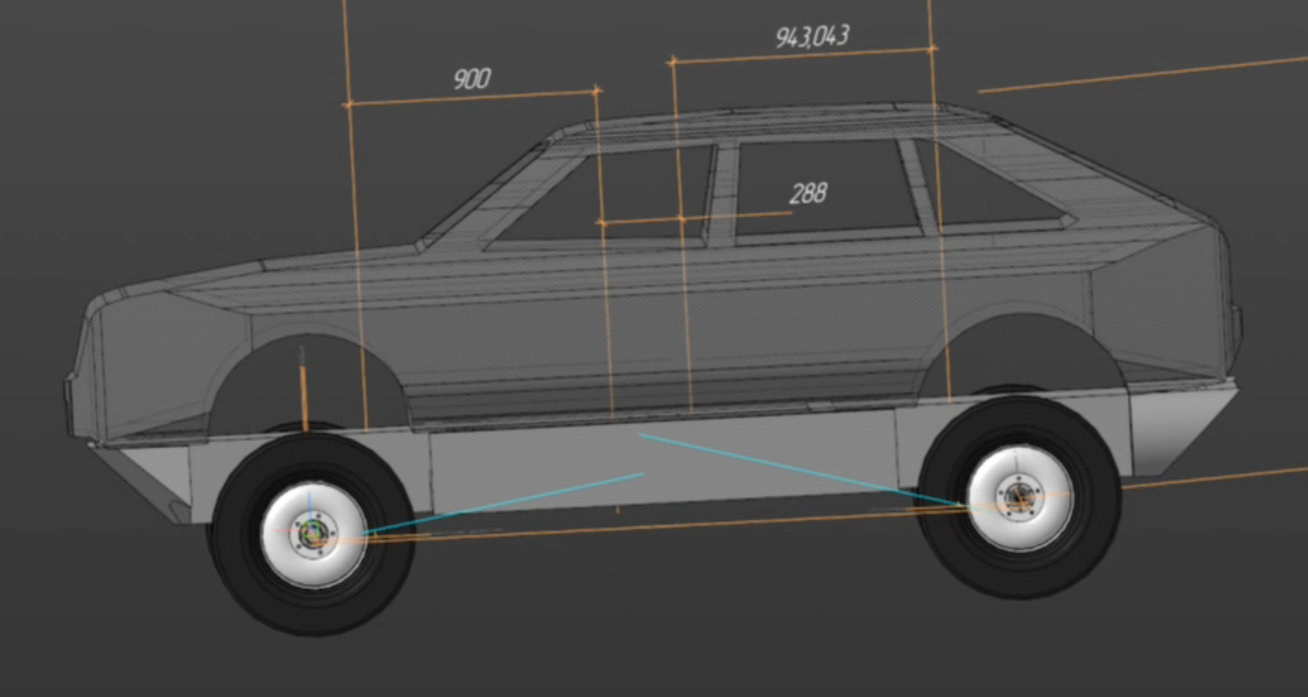
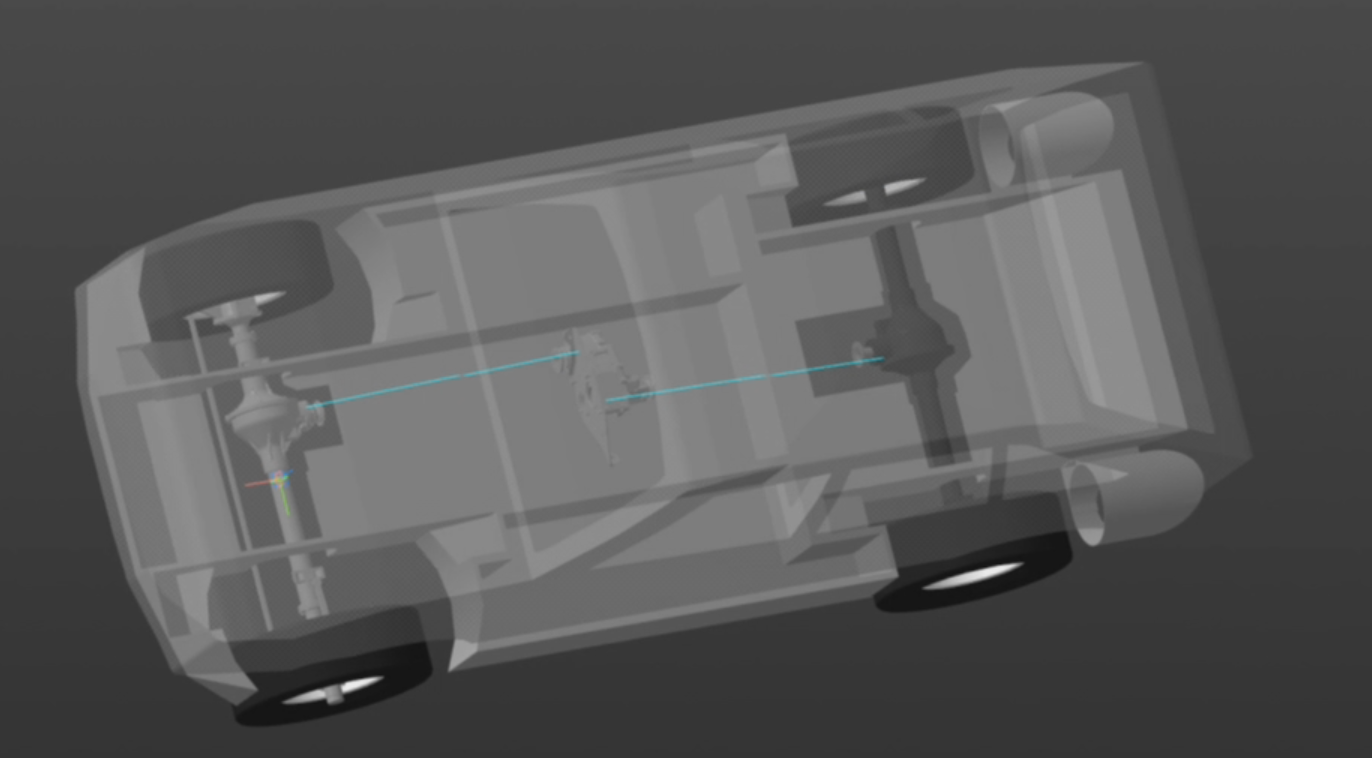
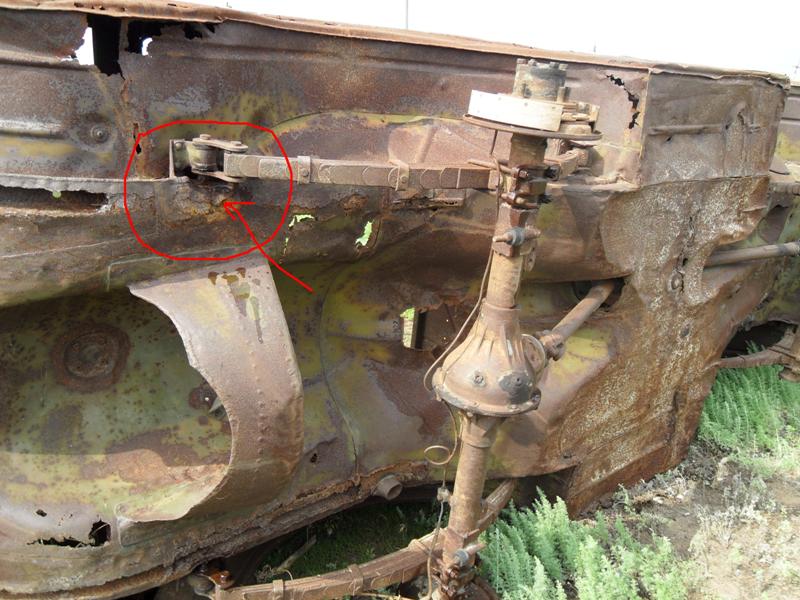
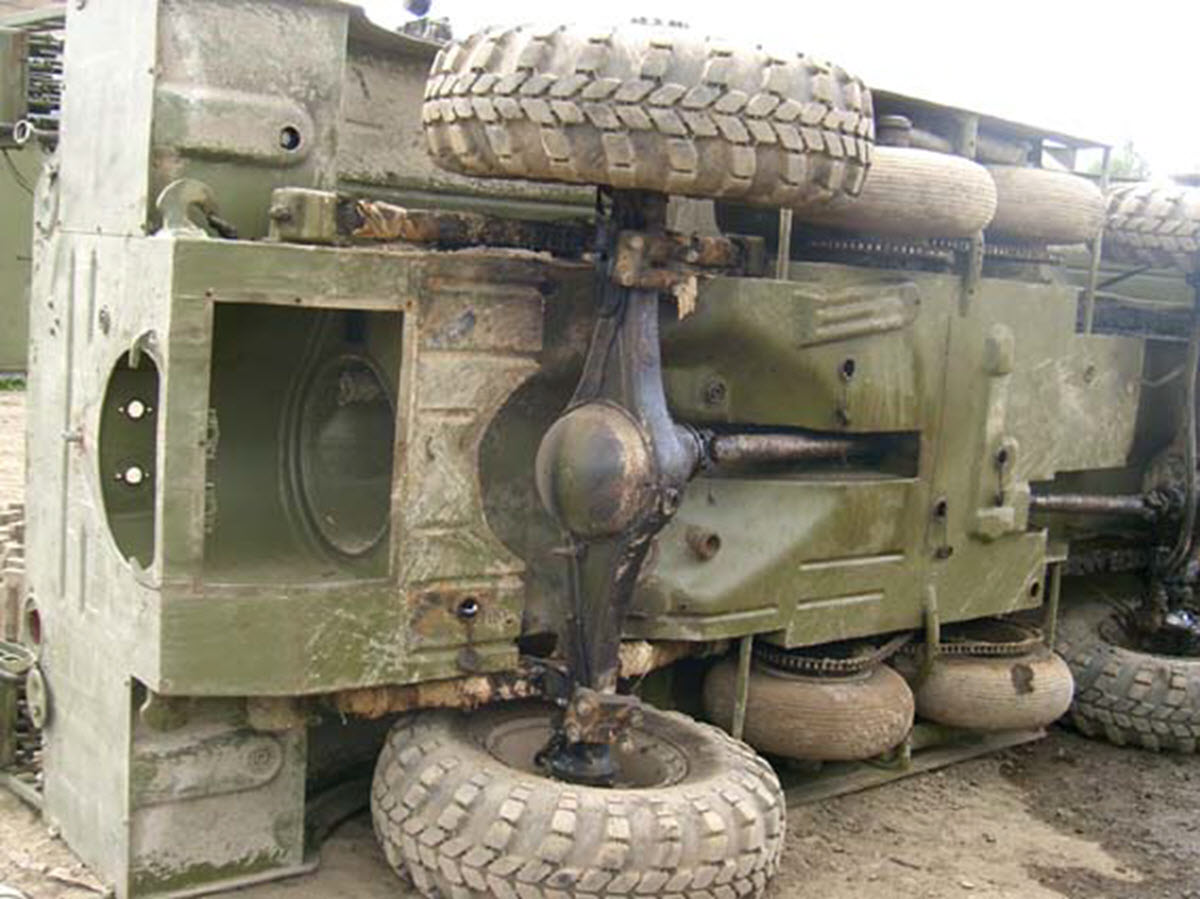
Among factory-built amphibians, similar hull recesses can be seen in underside photos of the GAZ-46 and BRDM-2 (Fig. 3, 4), illustrating the substantial hull volume sacrificed to provide clearance for suspension and driveline movement.
Steering System
The concept called for using the stock UAZ Bukhanka steering box mounted in its factory location on the frame rail, transferring motion to the wheels via the stock drag link and tie rod ends. Because the wheelbases of the UAZ Bukhanka and the M2141 are very close, this setup almost completely preserves the factory UAZ steering geometry, eliminating the need for calculations, custom linkage design, or Ackermann corrections. This arrangement is also convenient for the displacement hull, since the steering box routes the linkage outside the frame rail.
Among the obvious complications was connecting the UAZ Bukhanka steering box — whose input shaft is nearly vertical — to the M2141 steering column, which is nearly horizontal. This idea was not developed in detail as the UAZ concept was eventually dropped. In broad strokes, one option was a chain of U-joints, though standard cardan joints are non-constant velocity joints, meaning U-joint phasing angles would have to be carefully matched to avoid uneven steering effort. Another option was using several constant-velocity (CV) joints, or sourcing a ~1:1 right-angle bevel gearbox from agricultural machinery.
Drivetrain
A VAZ or Polonez gearbox attaches to the stock UZAM engine via an adapter plate. From there, a custom intermediate shaft transfers rotation to a divorced UAZ transfer case (TC) — a solution previously proven on the 4×4 overland camper van built on a GAZelle and UAZ platform. Through matched stock driveshafts and hull sealing assemblies, torque is delivered to the UAZ Bukhanka axles. A power take-off (PTO) unit on the intermediate shaft was planned to drive the marine propellers.
A nice bonus of using the UAZ transfer case is its built-in independent driveline parking brake — simple and reliable.
Waterproofing and Hull Sealing
Drivetrain Sealing
Several approaches to drivetrain sealing were explored. Given that the vehicle has a watertight displacement hull tub housing most of the mechanical components, sealing can be done on the intermediate shaft — either right after the gearbox or right before the transfer case. The advantage is that only a single shaft needs to be sealed; the downsides are that the transfer case sits outside in the water, hull displacement volume is lost, and an extra hull recess is required.
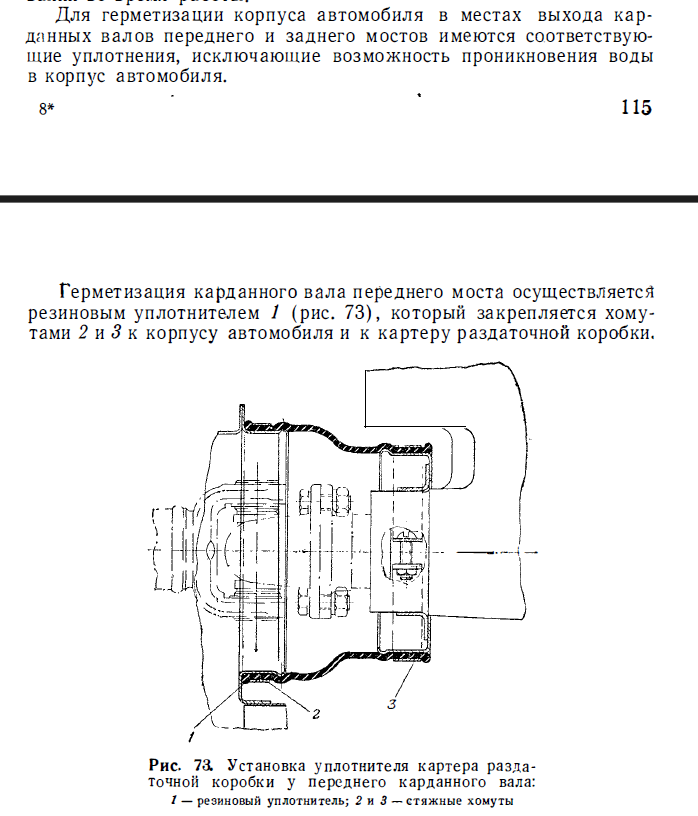
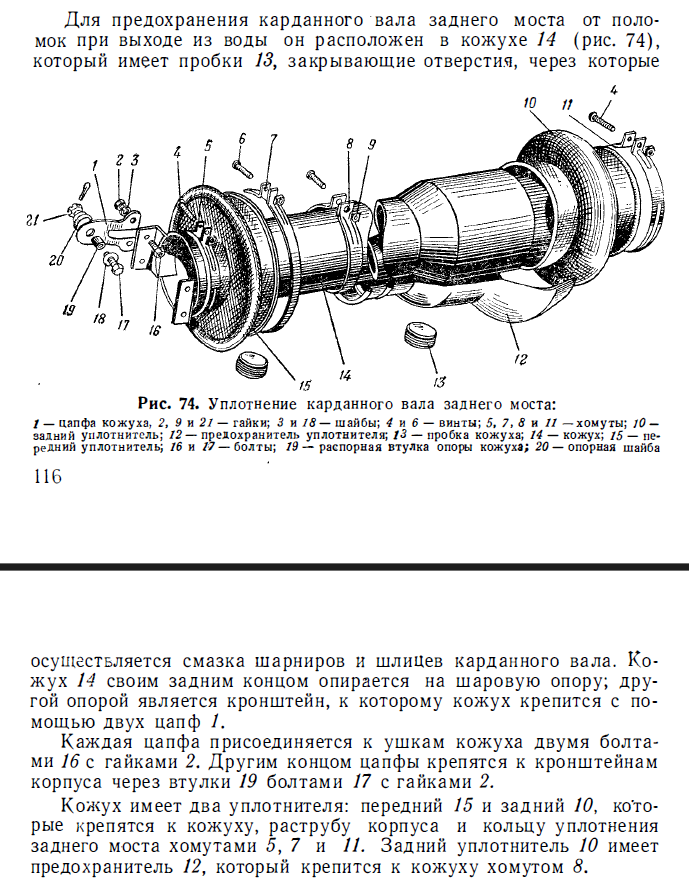
The most applicable factory reference is the GAZ-46 design (Fig. 5, 6), where the front driveshaft is sealed by the transfer case output lip seal combined with a rubber bellows boot between the transfer case housing and the hull bulkhead. Sealing of the rear driveshaft on the GAZ-46 is much more complex.
However, suitable off-the-shelf elastomeric boots (rubber-technical parts) could not be found for this layout, and the UAZ transfer case housing lacks mounting provisions to attach a bellows in a similar manner.
Possible workarounds included a carrier-bearing-style housing holding one end of a rubber bellows with the other end clamped to the hull, or a flange spacer on the driveshaft carrying a sealed bearing coupled to the hull via a bellows, or mounting a sealed bearing assembly directly in the hull bulkhead.
An additional utopian option — viable mostly in theory — is sealing at the axle pinion flanges. This would require large, heavy-duty bellows capable of accommodating 200 mm of vertical axle travel plus the seal diameter, 100 mm of lateral margin plus the seal diameter, and 100 mm of longitudinal travel plus the seal diameter. The advantage is minimal loss of displacement volume in the axle recesses. The drawbacks are major: (1) a huge custom bellows that, over such a large surface area, must withstand water pressure at a depth of 0.5 m with a safety margin, (2) high vulnerability to tearing on obstacles, and (3) rapid loss of buoyancy if punctured.
Another utopian option is sealing between the hull and the axle tubes, similar to how the independent suspension half-shafts are sealed on the LuAZ-967 (Fig. 7). However, the LuAZ uses independent suspension where the hull aperture sits roughly midway along the swing arm, meaning the required sealing aperture travel is half of the wheel travel. Its advantage is maximizing the enclosed displacement hull volume. The drawbacks are the same as the previous option, multiplied by four large bellows. Worse still, allowing downward suspension travel of a solid axle would require hull recesses extending 100 mm below the UAZ axle tubes and differential housings — leaving a ground clearance at those hull overhangs of only about 100–120 mm on stock tires.
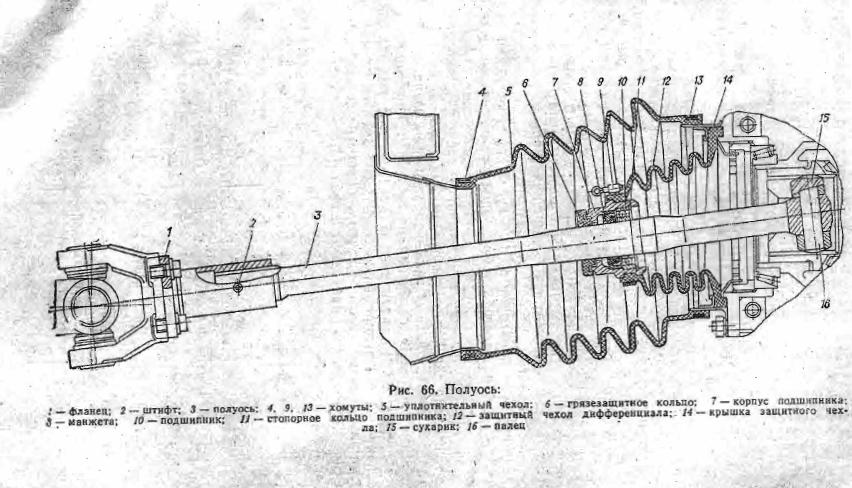
All of these methods share one critical flaw: they rely on large-surface-area rubber boots which, if torn or punctured, result in a massive hull breach.
Steering Sealing
Sealing the steering system is relatively straightforward. The steering box routes drag link motion outside the frame rail via the Pitman arm, while the steering sector shaft itself is sealed by a factory radial lip seal.
Steering waterproofing can be divided into two stages:
- Primary seal — between the steering box housing and the hull, sealed by the steering box’s own shaft lip seal (a very reliable connection);
- Secondary seal — if there is a desire to gain a bit more displacement volume, a rubber bellows can be fitted over the drag link and connected to the watertight left front nose compartment. If the outer bellows is damaged, water only reaches the primary steering box seal.
Brake System
Implemented by routing the primary and secondary circuits from the brake master cylinder to the front and rear UAZ axles respectively.
Conclusion and Results
The project was halted at the stage of concept development, preliminary calculations, and CAD drawings. Key shortcomings identified included excessive vehicle mass (around 1.7 tonnes), deep water draft (around 50 cm), difficulty of reliably sealing moving driveline assemblies, fabrication complexity, high unsprung mass, and high hydrodynamic drag. On 28.05.2026, this direction was shelved and evolved into the next-generation design based on Lada Niva 2121 assemblies.
One Reply to “Moskvich 2141 Amphibian Based on UAZ (Abandoned Project)”