

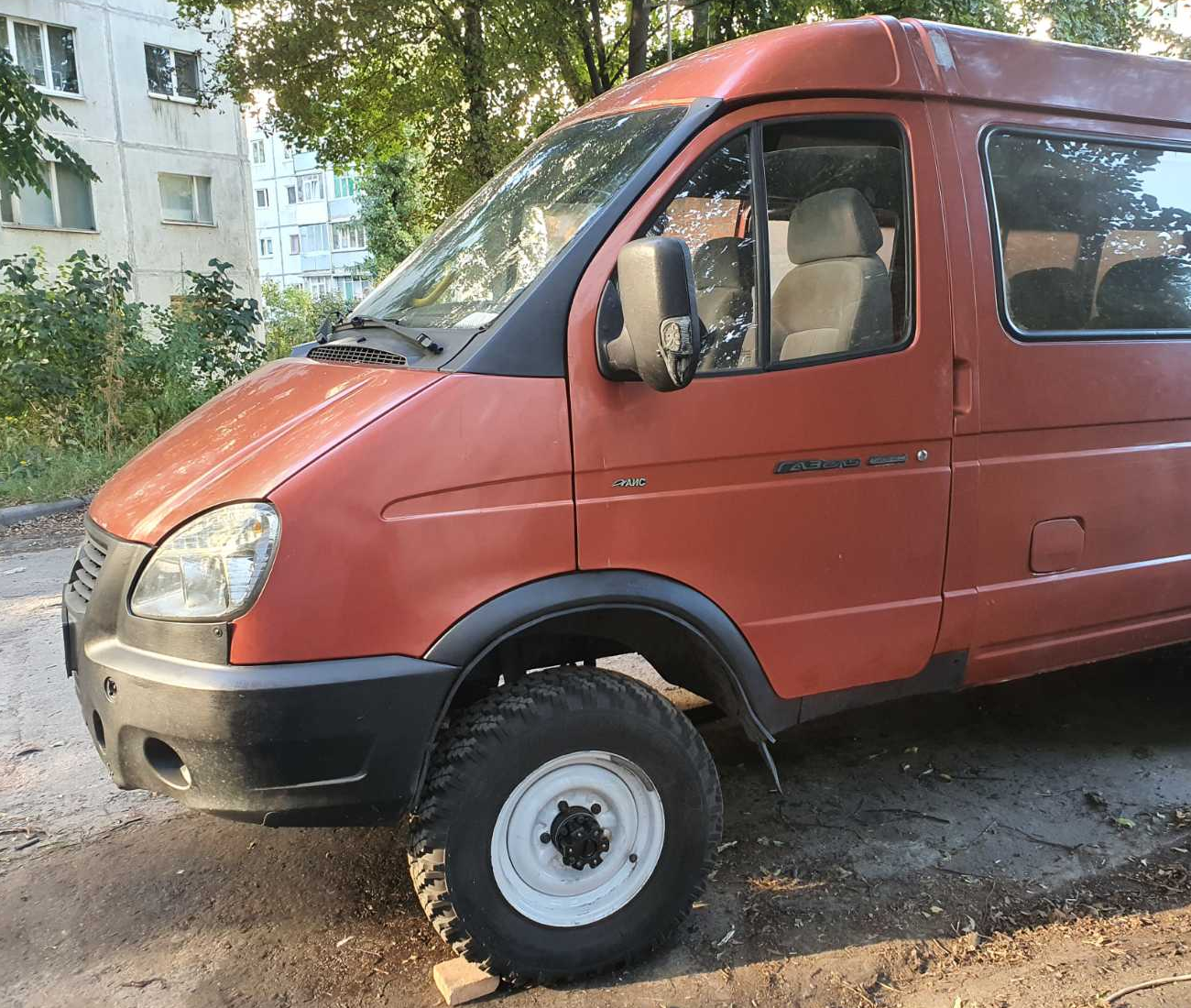
This project has a long and somewhat romantic backstory. I used to own a classic UAZ “Bukhanka” — a vehicle I invested a massive amount of time and effort into, and which suited my needs completely. After parting ways with it, I wanted a high-clearance, four-wheel-drive van. A classic body-on-frame SUV is great, but I wanted more interior space, while a standard commercial minibus offered zero off-road capability. Eventually, I was lucky enough to find a near-perfect base platform: a passenger GAZelle van in excellent condition, matching my driver’s license category, with an already installed LPG system (tank mounted outside the cabin) and the maximum registered seating capacity.
Project Objective: Building a four-wheel-drive vehicle on the GAZelle platform using simple, robust, and readily available mass-produced automotive assemblies, keeping one-off bespoke parts to an absolute minimum.
Since the ultimate utilitarian vehicle (“Bukhanka”) was invented long ago, I decided to maximize the use of UAZ components. The core concept of the project is minimum custom parts, maximum stock, reliable, and accessible components. Both vehicles share similar weight characteristics: the GAZelle was originally designed for commercial passenger and cargo hauling, while the UAZ was engineered as an honest, rugged off-roader.
Axle Selection and Suspension Kinematics
The choice fell on classic UAZ “Timken” civilian split axles due to their widespread availability and the ability to widen the track width relatively easily while retaining standard factory half-shafts. Because the primary operational profile consists of public roads, long-distance trips, and daily driving mostly around the city, preserving proper geometry was paramount: maintaining factory specs where critical (scrub radius) and recalculating geometry for the new dimensions (Ackermann steering angle, wheelbase-to-track ratio).
Among the Options Considered:
- Reduction (“Military” Portal) Axles: Feature a more complex design and require extra maintenance, which is redundant for city conditions. Spare parts are more expensive and harder to find. The main hurdle was widening the track:
- Widening axle tubes and half-shafts — undesirable in terms of reliability and repairability far from home;
- Installing wheels with large negative offset — keeps stock components, but critically increases the scrub radius, degrading handling and creating extreme loads on hub bearings.
- “Bars” and Wide “Spicer” Axles (1600 mm Track): Great off-the-shelf options, but extremely rare and expensive on the market, as are their original spare parts.
Track Width Calculations
The target value was the factory GAZelle track width of 1.7 m. In automotive engineering, there is a recommended ratio of wheelbase to track width (typically ranging from 1.8 to 2.2). The GAZelle wheelbase is 2.9 m. A stock UAZ axle with factory wheels has a track width of 1.44 m, which technically falls within the acceptable range (2.9 / 1.44 = 2.01). However, the GAZelle body is quite tall, and on uneven terrain, a narrow track would cause excessive, dangerous body roll.
By widening the “Timken” axles to 1.6 m, we achieve a ratio of ~1.81 (2.9 / 1.6). This allowed the vehicle to remain within standard stability benchmarks while providing a significantly wider and more stable track.
Ackermann Steering Geometry
The UAZ-452 and UAZ-469 vehicles have a 1.44 m track width and wheelbases of 2.3 m and 2.38 m, respectively. The GAZelle with widened axles has a 1.6 m track and a 2.9 m wheelbase. By retaining stock UAZ steering knuckles and proportionally scaling both key dimensions (wheelbase and track), the Ackermann steering angle closely converged with the kinematics required for the current geometry, eliminating parasitic scrubbing and tire wear in turns.
Drivetrain: Autonomous Transfer Case
Packaging the four-wheel drive proved tricky. The initial idea was to use an integrated UAZ gearbox and transfer case (TC) assembly, as they mate perfectly with UMZ engines. The problem is that the GAZelle engine sits much further forward relative to the front axle compared to any UAZ model. As a result, the front axle differential flange and the TC front output flange would have ended up too close to each other. The front driveshaft operating angle would have exceeded 45 degrees (mechanically impossible for universal joints), and driveshafts of such an extremely short length simply do not exist in nature.
The solution was creating a “divorced” (autonomous) transfer case. For the stock UAZ transfer case, a custom assembly was designed — dubbed the “TC Nose.” This is a specialized adapter and plates with dedicated bearings and oil seals, converting the transfer case into an independent unit. It now links to the stock GAZelle transmission via an intermediate driveshaft (jackshaft) built mostly from standard off-the-shelf parts.
Assembly Process: Zero Downtime
The longest delay in the project came from outsourced lathe and machining work, which contractors dragged out for several months. Due to this, active assembly only started in the autumn. But the most interesting engineering decision was the modular workflow: the vehicle was practically never out of commission for more than 1–2 days!
The process proceeded strictly in stages: while parts were being machined, the van was used daily in its stock configuration. First, the widened axles were prepared on the workbench. Then, over a single weekend, I rolled under and installed the front axle (the van continued driving daily in rear-wheel-drive mode with the factory GAZelle rear axle). Later, the rear UAZ axle was installed. Because the UAZ axle pinion flange sits closer to the axle centerline than the GAZelle’s, a custom spacer was fitted to the rear driveshaft. The vehicle drove in this RWD setup until the next warm season, when the divorced transfer case was hung, front-wheel drive was engaged, transfer case shift linkages were routed, and the handbrake was connected.
Cabin Layout for Travel
In parallel with the running gear, the interior was transformed. The cabin was completely stripped down, all hidden cavities washed, drain ports cleared, and coated with high-quality anti-corrosion wax. Vibration and acoustic deadening were applied, heavy-duty linoleum laid, and upholstery refreshed. In the rear of the cabin, a permanent bed was installed for sleeping on trips, along with a folding table conveniently accessible from both the bed and the swiveled rear passenger row.
Results and Operational Nuances
The conversion completely proved itself. Because the single-wheel UAZ solid axles are lighter than the GAZelle’s heavy dropped front beam and dual-wheel rear axle assembly, unsprung weight was noticeably reduced. In combination with high-profile tires and significantly lower operating pressure (around 2.0 bar / 29 psi on UAZ tires versus ~3.0 bar / 44 psi on stiff commercial GAZelle tires), the ride became much softer: the suspension absorbs minor bumps and pavement defects smoothly. And deep puddles that pose risks to ordinary passenger cars now barely reach the lip of the wheel rims.
A significant advantage was the UAZ handbrake, which is built as a separate brake drum on the transfer case, forming a simple, effective, and completely independent parking brake system.
Operational Characteristics and Downsides:
- Visibility: The seating position became higher, allowing a clear view of road conditions far over the roofs of passenger cars.
- Increased Height: The vehicle gained noticeable height both from larger-diameter wheels and from the front axle (+70 mm lift, since the leaf springs now sit on top of the axle tube, unlike the factory dropped beam of the GAZelle). Climbing into the cab became unusually high — quite a few pairs of pants were torn in the process!
- Overhead Restrictions: Due to the increased height, the vehicle no longer fits into all covered underground parking lots or garages with strict clearance limits.
Of course, this is not a full-fledged motorhome for year-round permanent living, but as a practical overland van for road trips and getaways, the project fully proved its worth: the cabin provides a comfortable place to sleep and work on a laptop, while the extra off-road clearance delivers confidence far from the asphalt.

One Reply to “Transforming a GAZelle Minibus into a 4×4 Overland Camper using UAZ Axles”